Table of Contents
ToggleUpgrading your outdoor lighting doesn’t have to mean settling for generic, mass-produced fixtures that fade and fail after a season or two. Hinkley outdoor lighting offers homeowners a practical alternative: premium, durable fixtures designed to handle the elements while delivering genuine style and function. Whether you’re mounting sconces beside your entry, stringing path lights down a walkway, or anchoring a statement pendant on your patio, Hinkley’s range covers real-world installations without the lifestyle-magazine pretense. This guide walks you through what sets these fixtures apart, how to choose the right style for your home, installation essentials, and how to keep them performing year after year.
Key Takeaways
- Hinkley outdoor lighting uses durable materials like powder-coated aluminum and marine-grade stainless steel specifically engineered to resist corrosion and weathering, outlasting budget fixtures by years.
- Precise lumen ratings and color temperature specifications (in Kelvin) ensure you choose fixtures that adequately illuminate your entry, patio, or pathway rather than guessing on light output.
- Wall-mounted sconces should be placed 5.5 to 6 feet above grade and 18 to 24 inches from doorway centerlines, while path lights work best spaced 6 to 10 feet apart for continuous, even illumination.
- Hinkley’s availability of replacement parts—gaskets, lenses, sockets, and shade assemblies—means you can repair individual components rather than replacing entire fixtures, maximizing longevity and value.
- Annual maintenance including gasket inspection, lens cleaning, and finish checks combined with basic seasonal care keeps Hinkley fixtures performing for 15–20+ years while reducing energy costs through LED efficiency.
What Makes Hinkley Outdoor Lighting Stand Out
Hinkley Lighting has built its reputation on durability and thoughtful design. Unlike budget fixtures that oxidize or corrode within a couple of seasons, Hinkley uses materials and finishes engineered specifically for outdoor exposure, think powder-coated aluminum, marine-grade stainless steel, and sealed optical glass that won’t cloud or frost prematurely.
The brand also pays attention to actual light output. Most Hinkley fixtures come with precise lumen ratings and color temperatures (measured in Kelvin), so you’re not guessing whether a sconce will adequately light your entry or just create a dim mood. You’ll find LED options across most models, which means lower wattage draws and far less heat output than older halogen or incandescent designs.
Another practical advantage: Hinkley sells replacement parts. A gasket wears out, a lens cracks, or a socket fails? You can often order that single piece rather than scrapping the entire fixture. That longevity translates to real savings, especially on higher-end installations where the upfront cost is meaningful.
Popular Hinkley Outdoor Lighting Styles For Every Home
Contemporary And Modern Designs
If your home leans minimal or modern, Hinkley’s contemporary collection delivers clean lines and geometric forms without looking sterile. Look for recessed fixtures, linear wall sconces with integrated LED strips, and pendant lights with simple metal frames and frosted glass. These work especially well on homes with flat rooflines, steel railings, or open-concept outdoor entertaining spaces.
Contemporary Hinkley fixtures often use brushed aluminum or matte black finishes that resist fingerprints and won’t show water spots as readily as polished chrome. They pair well with deck lighting, under-soffit installations, and pergola-mounted spots where the design intent is to illuminate without calling attention to the fixture itself.
Transitional And Classic Options
If your home sits somewhere between traditional and modern, a split-level, a colonial with updated interiors, or a farmhouse, Hinkley’s transitional and classic lines deserve a close look. These fixtures often incorporate tapered forms, bronze or oil-rubbed finishes, and subtle details like decorative braces or finialed tops.
These styles work across a wider range of home ages and architectural vocabularies. A classic Hinkley sconce with a clear seeded-glass lens reads well next to a paneled entry door or flanking a porch column. The bronze finishes develop a natural patina over years, adding character without looking neglected. The Spruce’s home improvement guides often showcase how transitional fixtures anchor both exterior entries and interior transitions, which applies equally to quality outdoor lighting choices.
Installation And Placement Tips For Maximum Impact
Before you drill into that wall, pause and think about function and sight lines. Are you lighting a path for safety, creating ambient glow for entertaining, or illuminating a focal point like a water feature or arbor?
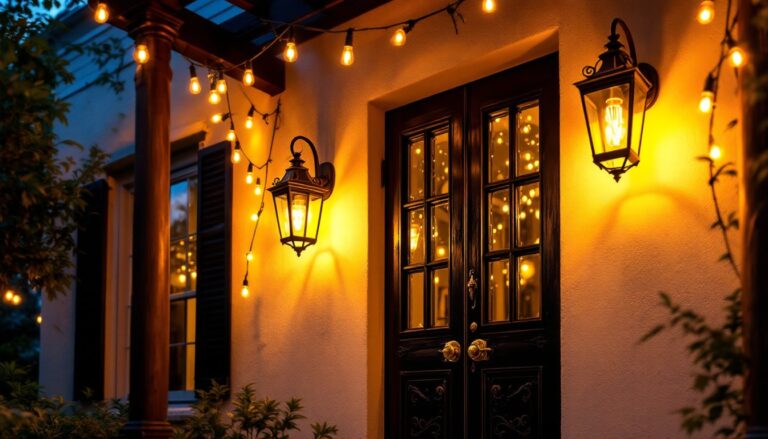
For wall-mounted sconces (which are popular Hinkley products), standard practice places fixtures 5.5 to 6 feet above grade on either side of a doorway, mounted 18 to 24 inches from the centerline of the door opening. This height and spacing ensure even light spread and shadow reduction without glare into approaching eyes. If you’re flanking a wide garage, adjust spacing to suit the opening width, often 36 to 48 inches apart works better.
Path and landscape lighting calls for different thinking. Hinkley path lights typically sit 12 to 18 inches tall and work best spaced 6 to 10 feet apart for continuous illumination without hot spots. Consider the sight line from your entry or deck, a row of lights disappearing toward a gate or garden creates visual depth.
Installation itself requires:
- Voltage verification (standard residential outdoor circuits run 120V: some low-voltage Hinkley options run 12V and need a transformer)
- Proper weatherproof outlet boxes if wiring directly to an outlet
- Conduit protection for any wire runs in exposed areas
- Permits if adding new circuits or significant wiring, check your local building department
- A second pair of hands for larger fixtures or high-placement work
If you’re uncertain about running new circuits or running conduit, hiring a licensed electrician saves headaches and ensures code compliance. Most installations (mounting a fixture to an existing box, swapping an old light for a new one) are straightforward DIY work if power is off and you follow the manufacturer’s wiring diagram.
Always wear safety glasses when working overhead, and keep power off during any wiring. Test continuity with a non-contact voltage tester before assuming a circuit is dead. Sunset magazine’s outdoor entertaining guides emphasize proper lighting placement for both safety and aesthetics, principles that matter whether you’re installing a single sconce or designing a whole-yard lighting scheme.
Maintenance And Longevity Of Your Hinkley Fixtures
Hinkley outdoor lighting is built to last, but it still lives outdoors. A little preventive care keeps fixtures performing and looking good for years.
Annual maintenance:
- Inspect gaskets and seals around lenses or glass panes. Over time, UV exposure and thermal cycling can degrade rubber gaskets: replacing a worn gasket is a $5–15 job that prevents water intrusion.
- Clean glass or acrylic lenses twice yearly with a soft, damp cloth and mild soap. Avoid abrasive scrubbing pads: they’ll scratch acrylic and may dull frosted finishes.
- Check metal finishes for rust, especially in coastal areas. A light wire brush and touch-up paint (Hinkley often sells color-matched touch-up kits) prevent corrosion from spreading.
- Replace LED bulbs if they’re included with the fixture, though modern LED modules are usually sealed and rarely need replacement within the fixture’s useful life.
Seasonal care:
Before winter, clear any debris from fixture housings and ensure water can drain freely. If you live in heavy snow country, consider removing or protecting low-mounted fixtures from snow-load damage. After rough weather, do a visual walk-around, a bent shade or loose lens might indicate impact damage worth addressing before water gets inside.
Hinkley’s design for repairability is a real advantage. Most fixture housings use standard parts, lenses, gaskets, sockets, even whole shade assemblies, that you can order through online retailers or specialty lighting suppliers. This modularity means a crack or failure doesn’t necessitate replacing the entire fixture.
With reasonable care, a Hinkley outdoor fixture typically lasts 15–20+ years, far outlasting cheaper alternatives and justifying the initial investment. LED efficiency also means lower energy costs compared to halogen or incandescent outdoor lighting, so you’re banking savings over time.
Conclusion
Hinkley outdoor lighting won’t solve a broken gutter or a cracked foundation, but it will transform how your home performs and looks after dark. Quality fixtures, thoughtful placement, and basic maintenance create outdoor spaces that actually feel safe and inviting. Whether you’re replacing a single fixture or planning a whole-yard lighting refresh, Hinkley’s range of styles, durability standards, and genuine brightness make the premium price tag a practical investment, not just a luxury upgrade.