Table of Contents
ToggleA kitchen island is the heart of modern homes, where family gathers, friends linger over coffee, and the real cooking happens. But without the right lighting, that beautiful island becomes a dimly lit workspace or a harsh, uninviting space. Kitchen island pendant lighting doesn’t just solve a functional problem: it sets the tone for your entire kitchen. Whether you’re drawn to industrial minimalism, mid-century warmth, or contemporary sleekness, the right pendants can transform your island from overlooked to outstanding. Let’s walk through what matters when choosing modern kitchen island pendant lighting ideas that work for your space and style.
Key Takeaways
- Kitchen island pendant lighting serves triple duty as task lighting, ambient lighting, and a visual focal point that sets the tone for your entire kitchen design.
- Modern pendant lighting styles—minimalist, industrial, contemporary, and mid-century—each offer distinct aesthetics; choose based on your kitchen’s color palette and cabinetry style.
- Hang pendants 30 to 36 inches above the counter surface, size shades to about one-third your island’s width, and space multiple pendants 24 to 30 inches apart for optimal coverage and visual balance.
- Match pendant finishes (matte black, brushed nickel, brass, or copper) to your kitchen hardware and appliances to create intentional cohesion rather than visual clutter.
- Dimmers, bulb selection (2700K for warmth, 3000K for task lighting), and strategic light direction maximize both functionality and ambiance throughout the day.
Why Kitchen Island Pendant Lighting Matters
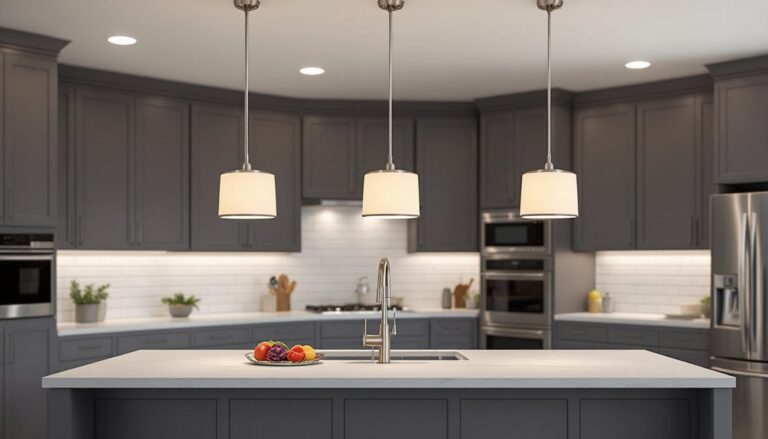
Pendant lights over a kitchen island serve triple duty: task lighting for food prep, ambient lighting for the whole kitchen, and visual focal point that anchors the space. Without proper lighting, you’re squinting while chopping vegetables or creating harsh shadows across the work surface. Good pendant design balances function with aesthetics, those fixtures need to deliver light where it’s needed while looking intentional, not haphazardly hung.
Modern kitchen design increasingly treats the island as a design statement, not just counter space. Pendant lighting is your chance to reinforce that statement. The height, spacing, and style of your pendants affect how the kitchen feels during morning coffee runs and dinner prep. Inadequate lighting forces you to rely on overhead fixtures, which cast shadows directly over prep zones. Properly positioned pendants eliminate that problem while creating visual interest and layering your kitchen’s lighting design.
Building code and safety matter here too. Kitchen work surfaces need a minimum illumination level, typically 50 foot-candles for general task lighting according to IES standards. Pendants alone may not meet this requirement: they work best paired with recessed overhead lights or under-cabinet fixtures. If you’re rewiring for new pendants, you’ll need permits and may need to consult an electrician, especially if running new circuits.
Popular Modern Pendant Lighting Styles for Kitchen Islands
Minimalist and Industrial Designs
Minimalist and industrial pendants dominate modern kitchens for good reason: they’re honest in design, blend with nearly any kitchen aesthetic, and focus on function first. Industrial styles typically feature exposed bulbs, metal cages, Edison-style bulbs, or bare sockets, think bare metal shades in black, brushed nickel, or aged copper. These fixtures work because they don’t pretend to be anything other than what they are.
Minimalist pendants strip away ornament entirely. Clean lines, geometric shades (cylinders, cones, or rectangles), and neutral materials define this approach. A matte black dome or a simple frosted glass cylinder creates a modern vibe without visual clutter. Industrial and minimalist styles pair well together, a black metal cage with a single exposed bulb reads as both minimalist in form and industrial in spirit. These designs work across color palettes because they’re intentionally restrained.
Contemporary and Mid-Century Inspirations
Contemporary pendant design borrows from mid-century modern, curves, organic shapes, and warm materials like wood or brass. A sculptural glass shade, a drum-shaped pendant with a wooden accent, or brass dome with clean proportions fit this category. These pendants have personality without breaking cohesion: they’re visually engaging without demanding all attention.
Mid-century pieces often feature warm metals, brushed brass, warm copper, or gold-toned finishes, paired with clean geometric forms or subtle curves. A contemporary kitchen lighting approach balances these warm metallic elements with modern minimalism. Pendants in this style work especially well in kitchens that blend traditional cabinetry with modern surfaces. They feel both timeless and current, which is why mid-century inspired pendants consistently top design trends. They’re safe choices that age well and avoid looking dated.
Choosing the Right Size, Height, and Placement
Size and spacing require actual math, skip this step and your pendants either dominate the island or disappear. A standard rule: pendant shades should be about one-third the width of your island. If your island is 3 feet wide, aim for a shade roughly 12 inches in diameter. For islands 4 feet or wider, consider two or three smaller pendants rather than one oversized fixture.
Height matters tremendously. Hang pendants 30 to 36 inches above the counter surface, low enough to deliver task lighting without creating a collision hazard or creating tunnel-like shadows. If your island is narrow (under 2.5 feet), center a single pendant. For wider islands, space two or three pendants evenly: a common pattern is to space them 24 to 30 inches apart, centering the group over the island. Test placement before finalizing: use painter’s tape to mark where the canopy (the base plate where wiring connects) will mount on the ceiling.
Electrical rough-in height matters too. Pendants hang from a ceiling box (typically 3 to 4 inches deep). Measure from the bottom of your existing joists down to your planned hang point, you need enough clearance for the box and wiring. If your ceiling is lower than 8 feet, consider smaller diameter shades and lower hanging lengths to avoid an overcrowded feel. Work with an electrician if you’re adding new circuits: rough-in requirements vary by local code and existing infrastructure.
Color and Material Options for Every Kitchen
Metal finishes dominate modern kitchen pendant choices. Matte black is nearly universal, it grounds a space visually and hides dust. Brushed nickel and chrome work in contemporary kitchens and blend with stainless steel appliances. Brass and copper tones warm a space and pair beautifully with white or neutral cabinetry: they’re trending because they feel intentional, not cold. Match your pendant finish to your kitchen hardware: cabinet pulls, faucet trim, and appliance handles should echo your pendant finish family.
Glass shades offer versatility. Clear glass is practical and modern, it shows off your bulb choice (increasingly decorative with LED technology). Frosted or opal glass softens light and feels contemporary without glare. Smoked or tinted glass adds visual interest and a sophisticated edge. Avoid heavily colored glass in kitchens: it filters task lighting and looks dated quickly.
Wood accents, walnut, oak, or bamboo, add warmth without fussiness. These work best in kitchens with wood islands or adjacent wood cabinetry. A wood pendant paired with a black metal frame reads as modern, not rustic. Ceramic or concrete shades suit industrial schemes but require careful bulb selection to avoid visible shadows cast through the material.
Bulb choice affects your whole aesthetic. LED vintage or Edison-style bulbs have become sophisticated, opt for warm white (2700K color temperature) for ambient warmth, or neutral white (3000K) for task lighting. Dimmable LEDs let you adjust ambiance without rewiring. Match bulb style to your shade: exposed filament bulbs look intentional in industrial cages but silly in frosted glass pendants where they’re barely visible.
Lighting Features to Enhance Functionality and Ambiance
Dimmers transform pendant lighting from utilitarian to flexible. A pendant that’s appropriate for task lighting can feel too bright during dinner: a dimmer switch lets you adjust from 50 foot-candles down to ambient warmth. Install dimmers on the same circuit as your pendants: you may need a licensed electrician to wire separate circuits if combining with overhead fixtures.
Bulb wattage affects both function and bulb choice. Pendant shades concentrate light in a smaller area than overhead fixtures, so lower wattage often suffices. A 40-watt equivalent LED (roughly 6 watts actual draw) works fine in most residential pendants: 60-watt equivalent for task-heavy areas. Avoid bulbs rated above the fixture’s maximum wattage: overheating can damage sockets and shades, especially in enclosed fixtures.
Light spread and direction matter for kitchen work. A shade that directs light downward (like a dome or cone) focuses task lighting precisely. A pendant with an open bottom spreads light more broadly, which reads softer but requires careful placement to avoid glare. Pendant clusters with separate shades give you more control, each can have a different direction or opacity. This approach works well for islands longer than 4 feet, where a single pendant can’t deliver consistent light across the entire surface.
Color temperature sets mood. A practical approach to kitchen lighting balances 2700K warm white for ambiance with strategic 3000K neutral task lighting. If your pendants are your only island light source, aim for 3000K to support food prep: pair with lower wattage and a dimmer to soften the space when cooking finishes. Some kitchens use separate pendant circuits on different dimmers, one set for task work, another for evening entertaining. This flexibility costs more upfront but transforms how the space functions throughout the day.