Table of Contents
ToggleSolar-powered outdoor wall lighting is one of the easiest efficiency upgrades a homeowner can tackle without cutting into a wall or running conduit. Unlike traditional hardwired fixtures, solar wall sconces mount directly to exterior surfaces, charge during the day, and illuminate your patio, entryway, or garage at night, no electrician needed. With solar technology improving year after year, today’s models deliver reliable brightness, long battery life, and weather resistance that’ll last through seasons of rain, snow, and UV exposure. Whether you’re adding security lighting, creating ambient mood, or just lighting the path to your door, solar outdoor wall lighting offers flexibility, lower operating costs, and zero installation headaches that grid-tied systems demand.
Key Takeaways
- Solar power outdoor wall lighting requires no electrician, trenching, or ongoing utility costs, making it an affordable upgrade that costs $30–$150 per unit compared to grid-tied systems.
- Mount solar outdoor wall lighting in spots receiving at least 6 hours of unobstructed daily sunlight, positioned 4–6 feet high for ambient lighting or 7–8 feet for security coverage.
- Prioritize lithium-ion batteries (2000–3000 mAh capacity), monocrystalline solar panels rated for 25%+ efficiency, and IP65+ water resistance to ensure reliable performance through seasons of rain, snow, and UV exposure.
- Choose fixture types based on your needs: sconces for accent or task lighting (300+ lumens for visibility), motion sensors for security deterrence, and lanterns for ambient mood lighting.
- Perform annual maintenance by cleaning panels with mild soapy water, checking sensor alignment, and replacing batteries every 3–5 years to maximize solar efficiency and extend fixture lifespan.
Why Solar Outdoor Wall Lighting Is the Smart Choice for Your Home
The appeal of solar wall lights goes beyond the “set it and forget it” convenience. First, there’s the financial angle: no trenching, no licensed electrician visits, and no monthly utility charges once the fixture is mounted. A quality solar sconce costs $30–$150 per unit, depending on brightness and build, which is pennies compared to running new electrical circuits to an outdoor wall.
Second, solar fixtures eliminate downtime from power outages. If a storm knocks out grid power, your solar lights keep working, helpful if you’re fumbling for the front door key. They also offer flexibility in placement: you can mount them where an outlet doesn’t exist without running extension cords that invite tripping hazards or UV degradation.
Third, maintenance is minimal once installed. Solar panels self-clean in most weather, batteries last 3–5 years (replaceable), and there are no switches to flip or timers to adjust unless you want them. Many modern models include built-in dawn-to-dusk sensors that activate automatically, plus motion detection on premium versions for added security when you’re away.
Types of Solar Wall Lights and Which Option Suits Your Space
Solar outdoor wall lighting comes in several distinct forms, each serving different functional and aesthetic purposes. Knowing the difference helps you pick fixtures that match both your home’s architecture and your lighting goals, whether that’s task lighting, ambient glow, or security deterrence.
Sconces and Uplighting Fixtures
Traditional solar wall sconces mount flush against siding, brick, or stone and emit light downward or sideways to illuminate entry points, patios, and garden beds. These come in contemporary, farmhouse, and classic styles: a sconce with a 150–200 lumen output is plenty for accent lighting, while 300+ lumens work for task-oriented areas like garage entries. Uplighting fixtures cast light upward against the wall or nearby foliage, creating dramatic shadow effects at dusk. Both types are weatherproof (rated IP65 minimum, meaning dust- and water-resistant) and mount with simple L-brackets and stainless-steel fasteners.
Budget roughly $50–$120 per sconce depending on materials (plastic vs. metal) and whether it includes rechargeable lithium-ion or NiMH batteries. Lithium-ion lasts longer per charge cycle and handles cold climates better, though both are reliable in temperate regions.
Motion-Sensor and Lantern Styles
Motion-activated solar lights include a passive infrared sensor that triggers brightness when movement is detected within 20–30 feet. These excel for security purposes, illuminating your driveway when you pull in, or deterring unwanted activity at night. Paired with security lighting for your home, they’re a cost-effective first line of defense.
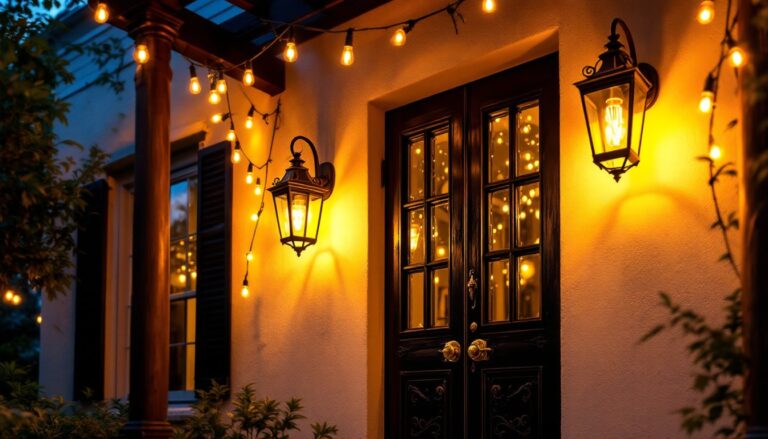
Solar lanterns are wall-mounted or hanging models that mimic vintage carriage lights or modern geometric designs. They’re purely aesthetic, offering warm ambient lighting for porches and patios. Lanterns typically run dimmer (80–150 lumens) than sconces, so use them where you want mood rather than visibility.
A well-reviewed solar lights option from CNET includes comparisons of sconces, motion sensors, and lanterns across multiple price points, helpful if you’re researching before buying.
Key Features to Evaluate When Selecting Solar Wall Lights
Not all solar wall lights perform equally, especially in variable climates or shaded locations. Here’s what separates reliable fixtures from ones that dim after one season.
Lumen output is brightness, measured in lumens. For ambient porch lighting, 100–200 lumens suffices: for security or pathway lighting, aim for 300+ lumens. Reputable manufacturers list this on packaging: if they don’t, that’s a red flag.
Solar panel size and efficiency determine charge speed and battery capacity. A 5–7 watt panel is standard for residential sconces: larger panels charge faster in overcast weather and store more energy for longer nights (critical in winter climates). Check that panels are monocrystalline (more efficient than polycrystalline) and rated for at least 25% efficiency.
Battery type and capacity matter enormously. Lithium-ion batteries (measured in mAh or watt-hours) outperform NiMH rechargeable batteries in cold weather and deliver brighter light per charge. A 2000–3000 mAh lithium battery will run 8–10 hours at full brightness: less capacity means dimmer output or shorter runtime.
IP rating tells you water and dust resistance. IP65 is industry standard for outdoor fixtures: IP66–IP67 offers extra protection if you live near salt spray or heavy rain. Check that fasteners are stainless steel or powder-coated steel to resist rust.
Dusk-to-dawn sensors and motion detection are conveniences. A built-in timer lets you set lighting hours without manual intervention. Premium models include adjustable brightness levels so you can dial down intensity on nights you don’t need full output, extending battery life.
Reviews on Digital Trends’ solar lights roundup provide real-world testing of brightness consistency, battery longevity, and weatherproofing claims across popular models.
Installation and Maintenance Tips for Long-Lasting Performance
Solar wall lights are forgiving to install, but skipping prep shortcuts your results. Here’s the process and key gotchas.
Pre-Installation:
Locate mounting spots that receive at least 6 hours of unobstructed sunlight daily, preferably south-facing in the Northern Hemisphere. Shaded corners and spots under eaves charge poorly, leading to dim or dead batteries by evening. Mark mounting heights: 4–6 feet above grade for ambient porch lighting, 7–8 feet for security coverage of wider areas.
Installation Steps:
- Clean the mounting surface with a wire brush to remove dirt, algae, or paint flecks.
- Use a level and tape measure to mark screw holes: standard spacing is 4–6 inches apart depending on bracket width.
- Drill pilot holes using a 1/8-inch drill bit into masonry or wood: pre-drilling prevents splitting wood and cracking stucco or brick.
- Fasten the mounting bracket with stainless-steel or galvanized screws (usually 2–3 inches long). Over-tightening cracks plastic housings: snug is enough.
- Slide the light fixture onto the bracket and secure with the set screw (usually an allen key).
- Remove the battery pull-tab (a strip inside the housing that isolates the battery) so charging can begin.
Maintenance:
Clean panels annually with a soft cloth and mild soapy water to maximize solar gain: dust and bird droppings reduce charging efficiency. Check that sensors face open sky without obstruction. Replace batteries every 3–5 years (most sconces have user-replaceable cells, costing $15–$40 per set). During winter, consider removing fixtures if heavy snow accumulates, the weight can stress mounting brackets, though most brackets handle 5–10 pounds.
If paired with living walls or vertical gardens for added privacy or aesthetics, ensure lights clear any tall foliage so their panels stay exposed to sunlight. For more complex DIY wiring or structural projects, Instructables tutorials offer step-by-step guidance on outdoor electrical work and mounting techniques.
Conclusion
Solar outdoor wall lighting delivers on its promise: efficient, low-maintenance illumination without the fuss of trenching or permits. By matching fixture type to your space (security, ambient, task), prioritizing battery quality and panel efficiency, and installing on sun-exposed walls, you’ll enjoy reliable lighting for years. The upfront cost is modest, ongoing maintenance is minimal, and the return on investment, both financially and in peace of mind, is immediate. If you’re looking to upgrade your outdoor space affordably, solar wall lights are one of the smartest, easiest DIY upgrades available.