Table of Contents
ToggleDusk to dawn outdoor lighting takes the guesswork out of nighttime home security and convenience. These fixtures automatically illuminate when the sun sets and switch off at sunrise, eliminating the need to manually flip switches or worry about forgetting your porch light on. Whether you’re aiming to deter intruders, light a pathway safely, or simply add visibility around your home’s exterior, dusk to dawn fixtures deliver consistent, hands-free performance year-round. This guide walks you through what these lights are, how they work, which types suit your needs, and how to install and maintain them properly.
Key Takeaways
- Dusk to dawn outdoor lighting automatically turns on at sunset and off at sunrise using a photosensor, eliminating manual switching and providing hands-free security and convenience year-round.
- LED dusk to dawn bulbs consume 75% less energy than incandescent alternatives, costing roughly $15–25 per year per fixture and paying for themselves quickly through reduced electricity bills.
- Choose brightness between 400–800 lumens for ambient pathways and 800–1200 lumens for security-focused entryways, and select 2700K for warm aesthetics or 4000K–5000K for enhanced nighttime safety.
- Installation is simple for bulb replacement in existing E26 sockets, but new integrated fixture installation requires proper weatherproofing, outdoor-rated wiring, and may need a licensed electrician for safety compliance.
- Regular maintenance—cleaning the photosensor every 6 months and inspecting caulking annually—keeps dusk to dawn fixtures functioning reliably for 5–10 years and prevents water damage or corrosion.
What Is Dusk to Dawn Outdoor Lighting?
Dusk to dawn outdoor lighting refers to fixtures equipped with a photosensor (also called a photoelectric eye) that detects ambient light levels. When daylight falls below a certain threshold, typically around dusk, the sensor triggers the fixture on. At sunrise, when light levels rise again, it automatically switches off. No timer, no app, no manual intervention required.
These lights use a daylight sensor to read surrounding illumination, so they adjust seasonally without any programming. If you live somewhere with significant seasonal variations, the lights naturally turn on later in summer and earlier in winter. The sensor continuously monitors light throughout the night, preventing accidental “off” commands from a passing car’s headlights or temporary shadows.
Most dusk to dawn bulbs are now LED (light-emitting diode) units, which use about 75% less energy than incandescent bulbs and last 15,000 to 50,000 hours or more. A standard dusk to dawn LED bulb typically draws 8–12 watts, compared to 40–60 watts for an older incandescent equivalent. This efficiency makes them ideal for fixtures left running 10–12 hours per day, every day.
Key Benefits for Your Home
Enhanced security is the primary draw. A well-lit perimeter discourages trespassers and burglars, who tend to avoid homes with clear sightlines and bright entry points. Unlike a porch light left on during the day (wasting energy), dusk to dawn fixtures activate only when needed.
Energy savings add up quickly. Running LED dusk to dawn bulbs for 12 hours daily costs roughly $15–25 per year per fixture, far less than constantly-on incandescent bulbs. Over five years, the difference compounds, especially if you have multiple fixtures.
Convenience and safety matter too. Visitors won’t stumble on dark steps, and you won’t fumble with keys at a dark door. Pathways, driveways, and deck edges become safer after sunset without you lifting a finger. Families with elderly relatives or young children benefit from consistent, automatic illumination during nighttime bathroom trips or emergencies.
Reduced maintenance burden is underrated. Set it once and forget it. Seasonal time changes don’t affect automated sensors, they adjust naturally. You’re not resetting timers twice a year or remembering to turn lights on and off manually.
Types of Dusk to Dawn Fixtures and Bulbs
Dusk to Dawn Bulbs
Standard A-shaped dusk to dawn LED bulbs screw into existing light sockets (E26 standard, the most common residential base). They cost $8–20 per bulb and work with standard fixtures. The photosensor sits in the bulb’s base, making them plug-and-play solutions. If you have an outdoor ceiling fixture or porch lantern, a dusk to dawn bulb is the simplest upgrade.
Integrated fixture dusk to dawn lights combine the bulb and socket as one unit. These bolt directly to walls, ceilings, or poles and often offer weatherproofing rated IP65 or higher (fully sealed against rain and dust). They run $25–80 depending on finish and brightness (lumens). Integrated fixtures suit garages, barn doors, and security applications where a sleek, sealed design matters.
Fixture Types
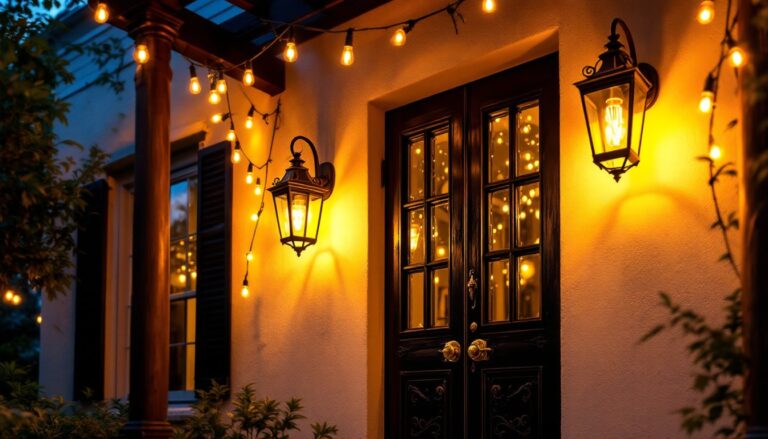
Porch and ceiling-mount fixtures hang from an eave or soffit and cast light downward onto entry doors, decks, or patios. They’re decorative and functional, available in many finishes from modern to traditional. Dusk to dawn versions maintain their style while adding automation.
Wall packs mount flat against a wall and project light outward. These suit garages, side yards, and anywhere you need directional, wide-angle illumination. Many include a motion sensor plus to the dusk-to-dawn photosensor, triggering brighter light when movement is detected.
Pole-mounted lights sit atop a post (4–14 feet tall) and illuminate large areas like driveways, yards, or parking spots. Dusk to dawn pole lights are common for rural properties or homes with significant setbacks from the street.
How to Choose the Right Fixture for Your Needs
Brightness (lumens) is the most critical spec. Standard household dusk to dawn bulbs range from 400–800 lumens, equivalent to a 40–60 watt incandescent bulb. For security-focused lighting on entryways, aim for 800–1200 lumens. For softer ambient lighting on decks or pathways, 400–600 lumens suffices. Check packaging for lumen ratings: don’t rely on wattage alone, LEDs deliver more light per watt than older bulbs.
Color temperature affects mood and function. 2700K (warm white) feels inviting and suits front porches or patios where aesthetics matter. 4000K–5000K (cool white or daylight) mimics natural light and works best for security or safety-critical areas like driveways and dark corners. Pick based on your home’s existing exterior lighting scheme.
Weatherproofing and durability depend on location. If the fixture sits on an exposed soffit, it’ll see rain, wind, and temperature swings. Look for wet-location-rated bulbs and fixtures rated IP54 or higher. Corrosion-resistant finishes (powder-coated aluminum, stainless steel hardware) extend lifespan in coastal or humid regions. Comparative reviews highlight longevity differences, top dusk-to-dawn LED bulbs from reputable manufacturers often outperform bargain knockoffs by years.
Sensor sensitivity and delay settings vary. Some fixtures let you adjust when the sensor “wakes up”, useful if streetlights or nearby lights trigger false activations. A programmable delay (e.g., 5 minutes before full off) prevents flickering if shadows pass near the sensor.
Existing fixture compatibility matters if you’re retrofitting. Most dusk to dawn bulbs fit standard E26 sockets, but check your fixture’s base size first. If you’re mounting a new integrated fixture, confirm your wall or eave can handle the mounting hardware and that you have proper outdoor-rated wiring nearby.
Installation Tips for DIY Homeowners
Before You Start
Turn off power at the breaker if you’re replacing a bulb in a permanently wired fixture. If you’re installing a new fixture, you may need to run electrical wire or relocate an existing outlet, work that requires a licensed electrician in most jurisdictions if it involves new circuits. Check local codes: many areas require permits for outdoor lighting additions.
Gather the right tools: a ladder, voltage tester, wire strippers, wire nuts, silicone caulk, and outdoor-rated fasteners. Outdoor fixtures sit in rain and UV exposure, so ordinary drywall screws or interior hardware will corrode and fail.
Bulb Replacement (Easiest)
- Turn off power at the switch or breaker.
- Let the existing bulb cool for 5 minutes if it’s been on.
- Unscrew the old bulb and set it aside safely.
- Screw in the dusk to dawn LED bulb hand-tight, don’t over-tighten, which can damage the base.
- Restore power and test after dusk.
Done. No wiring, no expertise needed. This works for any E26 socket.
New Integrated Fixture Installation
- Turn off power at the main breaker. Use a voltage tester to confirm no current flows.
- Remove the old fixture (if replacing one). Disconnect wires carefully: label them (black to black/hot, white to white/neutral, bare copper or green to ground).
- Install the mounting bracket to studs, joists, or solid wall anchors rated for the fixture’s weight. Most dusk to dawn fixtures weigh 2–5 pounds, so standard outdoor anchors work.
- Run wire through the fixture’s weatherproof entry conduit. Strip about ½ inch of insulation from each wire.
- Connect wires using waterproof wire connectors. Twist black to black, white to white, ground to ground, then screw on the connector until snug, no exposed copper.
- Caulk all entry points with outdoor-grade silicone to prevent water infiltration.
- Attach the fixture face plate and secure with provided hardware, use stainless steel or galvanized fasteners outdoors.
- Test for proper function. The sensor may need 30–60 seconds to calibrate before it responds.
If you’re uncomfortable working with electrical wiring, hire a licensed electrician. A single fixture installation typically costs $75–150 in labor, well worth the safety and warranty protection.
Positioning the Sensor
Place the photosensor where it’ll see clear sky and avoid direct streetlight glow. An overhang or soffit’s underside can trick the sensor if it’s shaded all day. Aim for a spot that gets genuine dusk-to-dawn light cycle.
Maintenance and Troubleshooting Common Issues
Routine Care
Clean the photosensor lens every 6 months. Dust, spider webs, and pollen buildup reduce sensitivity, causing the light to stay on longer than necessary. Use a soft, dry cloth or a slightly damp microfiber cloth. Never spray water directly at the sensor, it’s not sealed like the rest of the fixture.
Inspect outdoor-rated caulking annually. Gaps allow water to pool inside the fixture, corroding contacts and shortening lifespan. Reapply silicone caulk if you spot cracks or separation. In harsh climates, check after severe weather.
Common Problems
Light stays on all day or all night: The sensor is fouled or misaligned. Clean the lens first. If it persists, the sensor may be failing, replacement bulbs cost $10–20. Integrated fixtures with failed sensors may require professional replacement or circuit swapping.
Light flickers or cycles on and off erratically: Nearby motion-sensor lights or streetlights are likely triggering false activations. Reposition the fixture slightly or shield the sensor from direct glare. If the fixture has an adjustable sensitivity dial, turn it down a notch.
Dim output or uneven light: LED bulbs can dimly flicker if used on older dimmer switches or certain ballast-controlled circuits. Dusk to dawn bulbs shouldn’t be dimmed, use a standard on/off switch instead. For integrated fixtures, burnt-out LEDs aren’t field-replaceable: you’ll need a new unit.
Corrosion on hardware or visible rust: Remove and replace corroded fasteners immediately with outdoor-rated (stainless steel or galvanized) hardware. Rust spreads and weakens mounting security. Don’t ignore it.
Water pooling inside the fixture: Drainage holes may be clogged. Check the fixture’s base and any drain plugs for debris. Clear them and ensure the fixture tilts slightly downward so water runs off rather than pooling.
Most dusk to dawn LED bulbs last 5–10 years with minimal maintenance. Integrated fixtures often last longer if kept clean and dry. When in doubt, a quick call to the manufacturer or your electrician beats guessing.
Conclusion
Dusk to dawn outdoor lighting merges practicality with ease of use. Whether you’re retrofitting an existing fixture with an LED dusk to dawn bulb or installing a new integrated fixture, the upfront cost and installation effort pay dividends in energy savings, security, and peace of mind. Start with one fixture, perhaps a porch or entryway, and expand your outdoor lighting scheme as your comfort and budget allow. With proper sensor placement, routine cleaning, and attention to weatherproofing details, your dusk to dawn lights will run reliably for years.