Table of Contents
ToggleA good night’s sleep starts long before your head hits the pillow. The lighting in your bedroom plays a crucial role in signaling to your body that it’s time to wind down. Harsh overhead lights and bright screens suppress melatonin production, making it harder to fall asleep and stay asleep. Soft lighting for bedrooms isn’t just about aesthetics, it’s about creating an environment where your nervous system can genuinely relax. Whether you’re redesigning your entire bedroom or making simple fixture swaps, understanding how to layer soft lighting can transform your space into the restful sanctuary you deserve.
Key Takeaways
- Soft lighting for bedrooms supports melatonin production and your circadian rhythm by using warm color temperatures around 2700K, which mimics sunset and signals your body it’s time to sleep.
- Layering multiple light sources—such as wall sconces, bedside lamps, and dimmers—creates adjustable mood control rather than relying on a single ceiling fixture.
- Wall-mounted sconces installed at 60–66 inches from the floor provide practical reading light without illuminating your entire room, making them ideal for bedroom environments.
- LED bulbs compatible with dimmer switches offer flexibility and long-term energy savings compared to traditional incandescent bulbs, while smart bulbs allow scheduling gradual dimming before bedtime.
- A typical 150–200 square foot bedroom needs 1000–1500 total lumens from all sources combined; oversizing brightness defeats the purpose of creating a restful sanctuary.
- Always turn off power at the breaker and use a voltage tester before installing new fixtures, and consult local electrical codes to ensure safe installation of wall sconces and wiring.
Why Soft Lighting Matters for Bedroom Design
Your bedroom lighting directly affects your circadian rhythm, the internal clock that regulates sleep and wakefulness. Bright, cool-toned light (5000K and above) tells your brain it’s midday, keeping you alert. Soft, warm lighting (around 2700K) mimics the sunset, triggering your body to produce melatonin and cortisol, the hormones that prepare you for sleep.
Beyond biology, soft lighting creates psychological comfort. When you enter a bedroom bathed in warm, gentle light, your shoulders drop, your breathing slows, and your mind starts to decompress. This is why hotel suites, designed specifically for rest and relaxation, rely so heavily on layered, dimmable, warm lighting schemes.
The key is abandoning the single-fixture approach. A lone ceiling fixture, even if dimmed, creates flat, uninviting light. Home ambient lighting: Transform your bedroom by adding multiple light sources at different levels, overhead, wall-mounted, and task lighting, so you can adjust the overall mood and brightness as needed throughout your evening routine.
Types of Soft Lighting Fixtures for Bedrooms
Wall Sconces and Bedside Options
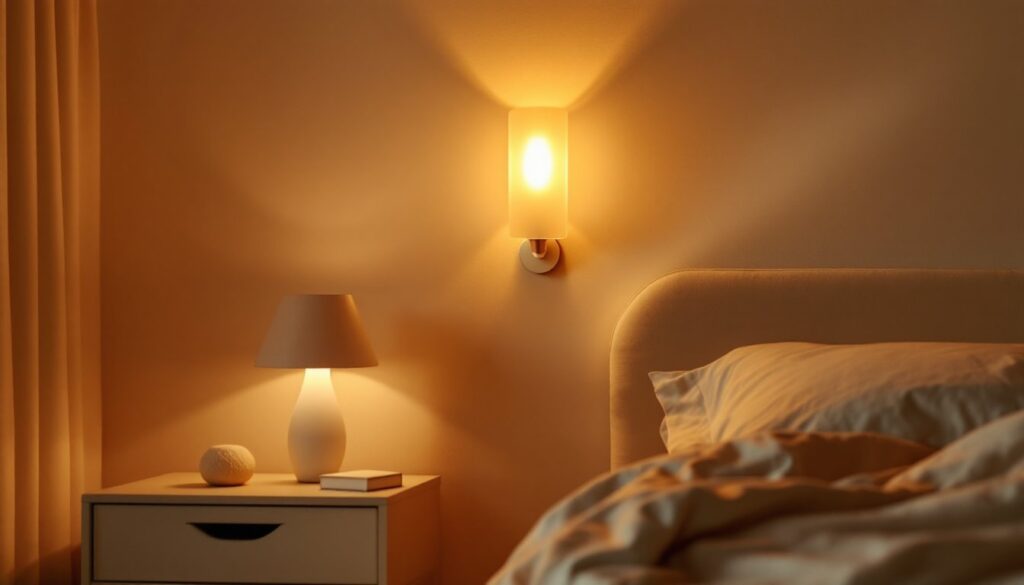
Wall sconces mounted on either side of the bed are arguably the most practical soft lighting choice for bedrooms. They provide localized light for reading without illuminating the entire room, and they don’t require bedside tables for lamp bases, valuable in smaller bedrooms.
Look for sconces with frosted glass shades or fabric diffusers that scatter light evenly rather than create harsh pools. Swing-arm sconces offer flexibility: you can position them closer to your book or fold them away when you’re sleeping. Install them at approximately 60 to 66 inches from the floor, roughly at eye level when you’re sitting up in bed.
For sconce wiring, you’ll typically run Romex cable through the wall studs and tie into a nearby outlet circuit or a new circuit if required by code (check your local IRC, International Residential Code, for junction box spacing and wire protection). If you’re uncomfortable with in-wall wiring, there are plug-in swing-arm options that mount with simple adhesive strips, though they’re less permanent.
Bedside table lamps (typically 40 to 60 watts or equivalent in LED) remain a classic choice. A fabric or linen shade diffuses light softly, while an opaque base directs light downward without glare. Pair these with a three-way bulb or a dimmer-compatible LED to control brightness as you settle in.
Dimmers and Adjustable Solutions
A dimmer switch is one of the simplest upgrades you can make. Standard incandescent and halogen dimmers work with most traditional bulbs, but not all LEDs. When choosing dimmers for LED bulbs, look for ones explicitly labeled “LED-compatible” or “dimmer-friendly.” Incompatible combinations cause flickering or won’t dim smoothly at all.
Install a dimmer by replacing your existing wall switch (turn off the breaker, test with a voltage tester, and follow the dimmer’s wiring diagram). Most dimmers are straightforward three-wire connections, though some have neutral wire requirements, check the packaging.
Smart bulbs and connected lighting systems (like Philips Hue or LIFX) give you control over color temperature and brightness from your phone. Some can be scheduled to gradually dim before bedtime, easing your transition to sleep. While the upfront cost is higher, the flexibility and energy savings often justify it over several years. Simple home theater lighting often uses the same dimmable, color-adjustable approach, and the principles carry over directly to bedrooms.
Choosing the Right Color Temperature and Brightness
Color temperature is measured in Kelvins (K). Warm white light (2700K–3000K) feels cozy and relaxing, ideal for bedrooms. Cool white (4000K–5000K) is energizing and better suited to workspaces. Daylight (6500K and above) mimics bright outdoor light.
For bedrooms, stick to 2700K bulbs as your primary lighting. This warm tone reduces blue light exposure and supports melatonin production. If you need extra task light for reading, a slightly warmer 2800K to 3000K bulb is acceptable.
Brightness, measured in lumens, should be moderate. A typical bedroom of 150–200 square feet works well with 1000–1500 total lumens from all sources combined. That’s equivalent to several 40-watt incandescent bulbs or roughly 8–12 watts per LED bulb depending on efficiency. The goal isn’t brightness for brightness’s sake: it’s layered control.
Decor experts at MyDomaine emphasize that soft lighting isn’t a one-size-fits-all solution, your preferred brightness depends on personal preference, age (older eyes need more light for reading), and the specific tasks you perform in your bedroom. Use dimmers and multiple fixtures so each person can customize their environment. Avoid placing bright light sources directly in your line of sight when lying down: position them to the sides or behind furniture to reduce glare.
Practical Tips for Installing Soft Lighting
Before You Start
Turn off power at the breaker and verify the circuit is dead using a non-contact voltage tester ($5–15). Sketch your bedroom to scale and mark where you want sconces, outlets, and switches. Check local codes for placement rules, many jurisdictions require outlets every 6 feet along a wall and specific rules for bathrooms (don’t apply directly to bedrooms, but good practice anyway).
Installation Steps for Wall Sconces
- Hold the sconce against the wall at your chosen height and mark the mounting holes with a pencil.
- Drill pilot holes if mounting into studs: use toggle bolts or appropriate anchors if mounting between studs (drywall anchors alone won’t safely support a heavy fixture).
- Route the electrical cable through the wall if you’re connecting to in-wall wiring, or use surface-mounted conduit for a cleaner look than exposed wire.
- Connect the fixture’s wires to your power source using wire nuts, matching black to black, white to white, and ground to ground (bare copper or green).
- Secure the fixture backplate and install the shade and bulb.
- Restore power and test.
Materials You’ll Need
- Soft-white LED bulbs (40–60 watts equivalent, 2700K)
- Wall sconce or fixture of choice
- Mounting hardware (typically included)
- 14/2 or 12/2 Romex cable (if running new circuits)
- Wire nuts, a voltage tester, and a drill with bits
- Dimmer switch (optional but recommended)
- Safety glasses and work gloves
Common Mistakes
Skipping the voltage test is dangerous: always confirm power is off before touching wires. Undersizing wire for the circuit amperage can cause fires, use 14 AWG for 15-amp circuits and 12 AWG for 20-amp circuits. Over-tightening mounting bolts can crack the fixture: snug them firmly but don’t force them.
If running new circuits, consult the NEC (National Electrical Code) for your region or, better yet, hire a licensed electrician. Bedroom lighting often requires a dedicated circuit in modern homes, especially if you plan to use multiple fixtures simultaneously. Lighting for home bar setups often involve more complex wiring: the same principles of circuit load and code compliance apply.
Conclusion
Soft bedroom lighting isn’t a luxury, it’s a practical investment in sleep quality and daily well-being. By combining wall sconces, dimmers, warm color temperatures, and layered fixtures, you create an environment that genuinely supports rest. Start with one upgrade (a dimmer or bedside sconce) and expand from there. Your future self will thank you every evening when you sink into that warm, gentle glow and feel yourself finally unwind.