Table of Contents
ToggleWhen dusk falls, the right outdoor lighting can make your yard feel like an extension of your home, or leave it dark and uninviting. Large outdoor lighting fixtures do more than illuminate: they anchor a space, set the mood, and add real architectural interest to your property. Whether you’re looking to light a patio, frame an entryway, or create dramatic uplighting on landscaping, the fixture you choose matters. This guide covers the practical essentials: what types exist, how to pick one for your specific space, what installation involves, and how to make your yard shine. Whether you’re a seasoned DIYer or tackling your first major outdoor project, you’ll find the knowledge to make an well-informed choice and execute it safely.
Key Takeaways
- Large outdoor lighting fixtures serve dual purposes—providing task illumination and creating architectural interest that anchors your outdoor space and enhances property aesthetics.
- Select fixture types based on function: post-mounted lanterns for pathways, wall-mounted for entryways, pendants for patios, and uplights for dramatic architectural highlighting.
- Hardwired large outdoor lighting fixtures require licensed electrician installation, GFCI protection, and permits in most jurisdictions; always check local electrical codes before starting.
- Layer your outdoor lighting with task, ambient, and accent sources to create depth and visual interest, and maintain consistent color temperature (2700K for warmth) across all fixtures.
- LED technology cuts energy costs dramatically—a 12W LED delivers the brightness of a 75W incandescent—while smart controls, dimmers, and motion sensors add convenience and security.
- Ensure proper installation with solid post foundations (24–30 inches deep in cold climates), secure wall backing, and rated hardware to handle weight and wind load safely.
Types of Large Outdoor Lighting Fixtures
Large outdoor fixtures come in several distinct categories, each suited to different jobs and aesthetics.
Post-mounted lanterns are workhorses for residential landscapes. These sit atop a 4×4 post (or similar) and typically stand 8–12 feet tall. They’re ideal for pathway lighting, marking entry points, or illuminating a driveway. A classic style works with traditional homes: modern minimalist designs suit contemporary properties.
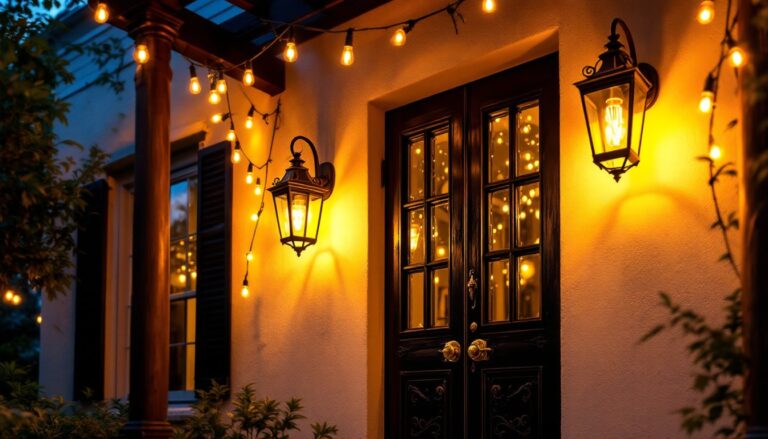
Wall-mounted fixtures attach directly to siding, trim, or a garage. The larger versions, sometimes called carriage lights or coach lights, project 12+ inches from the wall and throw light outward and downward. These work best flanking a front door or along a patio wall.
Pendant lights hung from a pergola or covered patio can be surprisingly large and dramatic. A 12-inch-diameter lantern or pendant sphere becomes a focal point when hung at eye level. This style bridges indoor and outdoor living and works well over dining areas or seating zones.
Uplights and spotlights are narrower, directed fixtures that throw light upward on trees, architectural features, or textured walls. They’re smaller in profile but make a bold statement when used in groups. These require planning and electrical work but deliver theatrical results.
String lights and festoon bulbs aren’t technically large fixtures, but oversized Edison-style bulbs (2 inches or larger) strung overhead create a different kind of impact, ambient and inviting rather than task-focused. They’re easier to retrofit and require minimal wiring if you use plug-in versions.
Choosing the Right Fixture for Your Space
Matching fixture type to function is the real skill. Start by asking: What am I lighting, and why?
Task lighting needs bright, focused illumination. A large post-mounted fixture with a 40W–60W equivalent LED bulb (500–800 lumens) typically illuminates a 15–20 foot radius. If you’re lighting a driveway or walkway, you need that range. Wall-mounted fixtures are similar but throw light in a narrower cone.
Ambient or decorative lighting prioritizes mood over brightness. A large pendant or post light with a 15W–25W equivalent LED (150–250 lumens) sets tone without washing out your space. Softer color temperatures, 2700K (warm white) rather than 5000K (cool/daylight), create a welcoming feel.
Architectural highlighting using uplights needs minimal brightness but precise aim. A 10W–15W LED spot is often enough if positioned correctly. The goal is shadow and drama, not general illumination.
Consider scale alongside function. A large fixture that’s out of proportion to your home or overpowering in a small space will feel awkward. A post-mounted lantern works in a spacious front yard: in a compact patio, a wall-mounted or pendant fixture often reads better. Look at Home Depot Overhead Lighting: for baseline fixture sizing and proportions.
Finish and material also matter. Powder-coated aluminum and stainless steel resist corrosion and salt spray in coastal areas. Brass and copper age gracefully outdoors but require maintenance if you want to keep them polished. Dark finishes (bronze, matte black, graphite) hide dirt and show light output more clearly than shiny finishes.
Installation Considerations for DIY Success
Before you buy, know your limitations and what you’ll actually need to do.
Hardwired fixtures require electrical work. If the fixture is going where no outlet or conduit exists, you’re running cable from a breaker, junction box, or existing fixture. This is not a casual weekend job: most jurisdictions require a licensed electrician for outdoor circuits, which must be protected by a ground-fault circuit interrupter (GFCI) per the National Electrical Code (NEC). Permits are often required, and inspectors will verify proper grounding, gauge of wire, and weatherproof connections. Check your local codes before planning.
Post-mounted fixtures need a solid foundation. A 4×4 post should be set 24–30 inches deep in concrete in freezing climates: 12–18 inches in mild regions. Nominal 4×4 lumber is actually 3.5 x 3.5 inches, which matters if your fixture has a specific post collar. The concrete should be rated for outdoor use (at least 4 inches of depth in the hole).
Wall-mounted fixtures need solid backing. Attaching to stucco, brick, or solid wood siding is straightforward: vinyl siding requires a backing board underneath. Use stainless steel or galvanized fasteners (not plain steel) to avoid rust staining.
Pendant fixtures on pergolas need a sturdy overhead structure rated for the weight and wind load. A pendant assembly can weigh 5–10 pounds: wind gusts create lateral stress. Make sure your mounting hardware is rated for outdoor use and your pergola posts and beams won’t flex.
Safety first: Always turn off power at the breaker before opening fixtures. Wear safety glasses and gloves when handling metal fixtures, sharp edges are common. If working at height, use a stable ladder and have a helper hold it. Read the manufacturer’s instructions carefully: every fixture has specific mounting requirements and weather-sealing steps.
Design Tips for Maximum Visual Impact
Scale, symmetry, and layering transform outdoor lighting from functional to stunning.
Symmetry works. Matching post-mounted lanterns flanking an entry or identical wall sconces on either side of a garage door create visual balance and look intentional. Asymmetrical arrangements require more skill and usually work better as accent lighting rather than primary fixtures.
Layer your lighting. A single large fixture leaves parts of your yard dark and flat. Combine a bright focal fixture (pathway lantern or wall sconce) with softer ambient lighting (a pendant overhead or string lights) and a hint of uplighting on plants or architecture. Three layers, task, ambient, accent, create depth and visual interest. Resources like Better Homes & Gardens and The Spruce frequently showcase outdoor schemes that use multiple light sources to maximum effect.
Color temperature consistency matters. Mixing 2700K (warm) fixtures with 5000K (cool) ones in the same zone looks disjointed. Pick one temperature and stick with it across all outdoor lights on that side of the house.
Uplighting on trees or architectural elements is subtle but transformative. Even one well-aimed 15W LED uplighter on a large tree or stone wall adds dramatic dimension, especially in evening photos. This works best when the uplight is hidden, pointing upward from ground level, so you see the effect, not the fixture.
Height variation creates visual interest. If all your fixtures sit at the same level, the yard looks flat. A post-mounted lantern at 10 feet, a wall sconce at 8 feet, and a pendant at 7 feet engages the eye at multiple levels. Explore design inspiration on Gardenista for examples of how landscape professionals vary fixture placement and height.
Energy Efficiency and Modern Features
LED technology has transformed outdoor lighting. A 12W LED bulb produces as much light (around 1000 lumens) as an old 75W incandescent and costs a fraction to run. Over a season, the energy savings add up, especially if your fixtures are on a timer or motion sensor.
Smart controls are increasingly affordable. A smart bulb or fixture controller lets you dim lights, change color temperature (if color-tunable models are installed), or turn lights on and off via phone. This is convenient for entertaining and adds a layer of security when you’re away (lights appear to be on even when you’re not home).
Solar-powered post lights are an alternative for locations where running electrical is impractical, though they’re typically smaller fixtures with modest brightness. Battery performance in winter and cloudy regions can be disappointing, so they work best in sunny climates and for accent, not primary, lighting.
Motion sensors and dusk-to-dawn photocells save energy by running lights only when needed. A dusk-to-dawn photocell on a hardwired fixture automatically turns lights off during the day: a motion sensor kicks lights on only when movement is detected. Both are excellent for security and cost-conscious operation.
Dimming capability is often overlooked but worthwhile. A dimmable LED bulb in a large fixture lets you adjust brightness for different occasions and times of year. Summer entertaining might call for full brightness: a quiet evening might need just 50%. This also extends bulb life and reduces energy consumption.
Conclusion
Large outdoor lighting fixtures aren’t an afterthought: they’re an investment in how your home looks and functions after dark. Choose fixtures that match your space’s scale and style, understand whether hardwiring or a simpler solution makes sense for your DIY skill level, and layer your lighting for maximum impact. LED efficiency, smart controls, and modern finishes mean today’s outdoor lighting is easier to install and cheaper to run than ever before. Start with one strong focal fixture, then build from there. Your yard, and your evening gatherings, will thank you.