Table of Contents
ToggleGood lighting can make or break a living room. It’s not just about seeing, it’s about creating a space that feels right whether you’re reading the morning paper, hosting dinner guests, or settling in for a movie. Many homeowners treat lighting as an afterthought, defaulting to a single ceiling fixture and hoping for the best. The reality is that thoughtful lighting design combines ambient, task, and accent layers to transform your room into something both functional and inviting. This guide walks you through practical ideas and specific fixture choices that’ll help you get lighting right in your living room.
Key Takeaways
- Effective living room lighting requires three layers—ambient, task, and accent lighting—working together to create flexibility, control, and atmosphere rather than relying on a single ceiling fixture.
- Calculate ambient lighting at 10 to 20 foot-candles (300 to 600 lumens for a 15×20-foot room) using energy-efficient LED bulbs, and install dimmer switches to adjust mood and energy use instantly.
- Layer task lighting near seating areas where you read or work, targeting 40 to 60 foot-candles at your surface, and add accent lighting with spotlights or backlighting to create depth and visual interest.
- Choose ceiling fixtures like pendant lights or chandeliers sized proportionally to your space—pendant shades should be about one-third the width of the area, and chandeliers sized in inches to match your room’s width in feet.
- Complement overhead lighting with wall sconces at 60 inches height and floor lamps spaced 8 to 10 feet apart to distribute brightness evenly, reduce shadows on faces, and add flexibility without rewiring.
- Use warm 2700K bulbs for cozy ambiance, cooler 4000K to 5000K tones for task lighting to reduce eye strain, and always select dimmable LEDs to adapt your living room lighting to different activities and times of day.
Understanding the Three Layers of Living Room Lighting
Professional designers talk about three layers of lighting, and for good reason, they work together to give you control, flexibility, and atmosphere. Skip one layer and you’ll end up fiddling with switches or squinting to read. Get all three right and your room adapts to whatever you need.
Ambient Lighting as Your Foundation
Ambient lighting is your baseline, the general illumination that lets you move safely through the room and see what’s in front of you. This usually comes from a ceiling fixture, but it can also come from multiple sources working together. The key is even, diffuse light without harsh shadows. A single bright bulb overhead often feels sterile: layering softer sources makes the room feel larger and more livable.
Calculate ambient light by aiming for 10 to 20 foot-candles in a living room (a foot-candle is one lumen per square foot). For a 15×20-foot room, you’re looking at roughly 300 to 600 lumens as your baseline. Modern LED bulbs make hitting this target cheap and energy-efficient, a 60-watt equivalent LED is around 800 lumens and costs just a few dollars.
When planning ambient light, consider your room’s color scheme. Light walls bounce light and make spaces feel airier: dark walls absorb it and make rooms feel cozier but may require slightly more lumens to feel bright enough. Install dimmer switches on your ambient fixtures, this one upgrade lets you adjust mood and energy use in seconds.
Task and Accent Lighting for Depth
Task lighting handles specific jobs: reading, assignments, working on a laptop. Accent lighting highlights architectural features, artwork, or plants, it adds depth and prevents your room from feeling flat. Neither is mandatory, but both transform a living room from functional to genuinely comfortable.
For task lighting, place fixtures where you actually sit. A floor lamp beside a reading chair or a table lamp on an end table works far better than hoping the overhead will cut it. Aim for 40 to 60 foot-candles at your reading surface, about three to four times your ambient level.
Accent lighting is about drama. A spotlight on a gallery wall, backlighting behind floating shelves, or uplighting in a corner adds dimension and draws the eye. These fixtures don’t need to be bright, they work by contrast and direction. Accent fixtures also set mood: warm 2700K color temperature feels intimate, while cooler 4000K feels modern and crisp.
Ceiling Light Fixtures That Transform Your Space
Your ceiling fixture is the anchor of your lighting scheme. It carries the weight of ambient light and sets the room’s visual tone. The good news is options abound: the challenge is picking what actually works for your space and wiring.
Modern Pendant Lights and Chandeliers
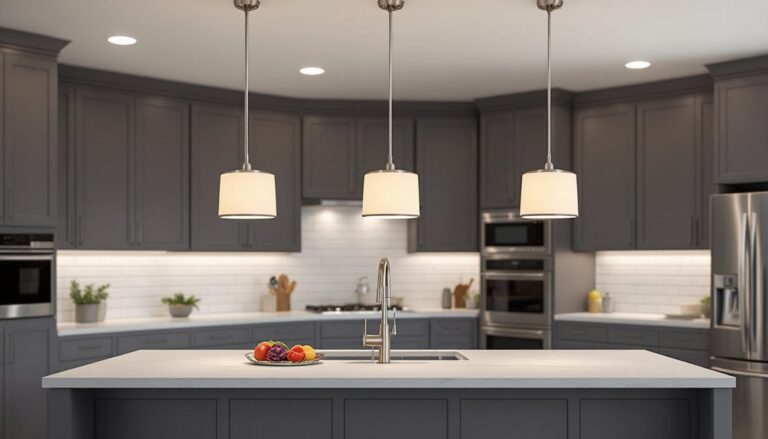
Pendant lights hang from the ceiling on a cord or rod and work beautifully over islands, seating areas, or in clusters. A single large pendant creates focal-point drama: three smaller pendants over a sofa add visual rhythm. Pendant lights let you choose the shade color and shape, matte black, brass, fabric, or glass, to match your style.
When sizing a pendant for your living room, aim for a shade diameter roughly one-third the width of the space you’re lighting. A 12-foot-wide seating area works well with a 4-foot-diameter pendant or a cluster of 10- to 12-inch shades spaced evenly. Install the bottom of the shade 18 to 24 inches above furniture (like the back of a sofa) so it doesn’t block sightlines.
Chandeliers make a statement and work especially well in rooms with 9-foot or higher ceilings. Standard chandeliers range from 20 to 40 inches in diameter. The math is simple: measure your room’s width in feet, and that’s your chandelier diameter in inches. A 14×16-foot living room suits a 28- to 32-inch fixture. Too small and it looks timid: too large and it dominates awkwardly.
One practical note: if you’re replacing an existing ceiling fixture, use the existing outlet box if possible, running new electrical is permitting territory and means hiring a licensed electrician. Check your Home Depot Overhead Lighting options to compare styles and wattages before buying.
For both pendants and chandeliers, always use a dimmer if your living room’s traffic pattern varies. Movie nights need soft light: game night might need brighter. Dimmers add flexibility without added cost.
Choosing the Right Fixture for Your Layout
Layout shapes your lighting strategy. An open-concept living room flows into a kitchen or entryway: a defined, enclosed room is self-contained. Both have different needs.
In an open layout, use ceiling fixtures strategically to define zones without walls. Pendants over a dining table, a chandelier over a seating area, and under-cabinet lighting in the kitchen create invisible boundaries. This tells your eye where one space stops and another starts, important because overhead light bounces everywhere without physical separation.
In a traditional, enclosed living room, a single ceiling fixture handles most of your ambient load, with task and accent pieces filling gaps. This actually gives you more flexibility because you’re not fighting an open floor plan’s competing light zones.
Think about how light falls on surfaces. A ceiling fixture creates downward light, useful but sometimes unflattering to faces and skin tone. Adding wall sconces at eye level (usually 60 to 66 inches from the floor) softens shadows and makes people look better. This is one reason restaurants and upscale homes combine ceiling and wall fixtures.
Consider your room’s natural light too. North-facing rooms stay cool and dim: they benefit from warm ambient light (2700K) to counteract that. South-facing rooms get bright afternoon sun: you might want cooler tones (3000K to 4000K) and more dimmer control because the combined natural and artificial light can feel overwhelming.
Measure before you shop. Know your room’s width, length, and ceiling height. Measure where furniture sits and where you actually need task light. A quick sketch, nothing fancy, just labeled distances, prevents expensive mistakes. Most fixture problems come from guessing dimensions and winding up with something that doesn’t fit the space or creates glare on your TV.
Wall Sconces and Floor Lamps for Flexible Brightness
Wall sconces and floor lamps give you control and flexibility that ceiling fixtures alone can’t match. They’re also easier to install and don’t require reopening walls.
Wall sconces mount directly to your wall, no rewiring needed if there’s already an outlet nearby. They work especially well flanking a mirror, artwork, or fireplace. For reading or accent, position them at arm’s height (around 60 inches from the floor) and roughly 18 to 24 inches apart. Sconces with adjustable shades let you direct light up, down, or sideways, useful for avoiding glare on screens.
Floor lamps are the DIYer’s best friend: plug one in and you’ve added task or accent light instantly. Arc lamps throw light across a wide area from a single corner: tripod lamps feel sculptural and modern. For reading, a task floor lamp with a narrow, focused shade works better than a wide diffuse one, you want light on your book, not bouncing everywhere.
When placing floor lamps, stay at least 8 to 10 feet from your main ceiling fixture to avoid overlapping pools of light (which looks chaotic) and to distribute brightness evenly. If you’re adding sconces, same rule applies, space them to balance each other and your ceiling fixture.
Bulb choice matters more in task and accent fixtures than ambient ones. For reading or detailed work, a crisp white light (4000K to 5000K) reduces eye strain. For living room ambiance, warm white (2700K) feels more relaxed. Dimmable LED bulbs are standard now and cost under $10 each, get them. They pay for themselves through energy savings and let you adjust mood without switching fixtures.
One safety tip: never run a lamp cord under a rug or across a foot traffic pathway. Damaged insulation is a fire risk. Route cords along walls and furniture backs. Use cord covers if the path is unavoidable, and inspect cords regularly for cracks or wear.
If your living room lacks the flexibility of sconces and floor lamps, consider the range offered in Home Ambient Lighting resources, which cover layered approaches to creating welcoming spaces. Adding even one well-placed floor lamp transforms how your room functions at night.