Table of Contents
ToggleSolar outdoor lighting has come a long way since those flickering path lights from a decade ago. Modern solar powered outdoor lighting delivers brighter, longer-lasting illumination while cutting your electricity bill and eliminating trenching for underground wiring. Whether you’re lighting a patio, securing entry points, or creating ambiance along a garden path, solar solutions now rival traditional hardwired fixtures in performance, without the installation complexity or ongoing utility costs. The technology has matured enough that homeowners can tackle these projects solo, and the payoff is genuine: no monthly charges, minimal maintenance, and zero permit headaches for most installations.
Key Takeaways
- Solar powered outdoor lighting eliminates monthly electricity costs and installation complexity compared to hardwired fixtures, saving $20–30+ annually per light while requiring no permits or trenching.
- Solar path lights cost $15–35 for mid-range quality fixtures with monocrystalline panels and reputable LEDs, delivering 8–12 hours of illumination and outperforming cheaper alternatives by a significant margin.
- Direct sunlight exposure of 6–8 hours daily is essential for solar lights to charge fully; shaded locations will underperform, so observe your site before purchasing.
- Modern lithium-ion and LiFePO4 batteries in solar lights last 5+ years with minimal self-discharge, making them superior to older NiMH batteries despite higher upfront costs.
- Solar motion-activated security lights produce 800–2,000 lumens on demand, offering genuine deterrent value without wired infrastructure and the ability to switch between motion-only and dusk-to-dawn modes to extend battery life.
- Choose warm white (2,700–3,000K) path lights for residential aesthetics and cool white (5,000K) for security zones; verify IP65+ rating for weather resistance before installation.
Why Solar Outdoor Lighting Is Worth the Investment
The economics work because solar lights operate independently from your home’s electrical grid. Once installed, you’re paying nothing per month, just the upfront cost of the fixtures and, potentially, occasional battery replacements after 3–5 years. For a homeowner running a 60-watt hardwired patio light eight hours a day, that’s roughly 175 kWh annually, translating to $20–30 a year depending on regional rates. Multiply that across multiple outdoor fixtures, and you’re looking at real savings over time.
Beyond cost, there’s the labor angle. Installing solar path lights takes five minutes per fixture. Installing hardwired security lights means running conduit, pulling Romex cable through walls, adding a junction box, and (in most jurisdictions) getting an electrician to handle it, $500 to $1,500 in labor alone, plus potential permit fees. For security lighting for your home, solar motion-activated fixtures offer a practical middle ground: genuine deterrent value without that wired infrastructure.
Solar also means flexibility. You can reposition lights seasonally, upgrade fixtures without rewiring, or move them if you change your landscaping. No trenching means no risk of hitting underground utilities, and no trenching means your yard stays intact, a huge advantage if you’ve just graded and seeded.
Types of Solar Outdoor Lighting Solutions for Your Home
Solar Path Lights and Accent Fixtures
Solar path lights are the bread and butter of solar outdoor lighting. They’re stake-mounted, typically 12–24 inches tall, with a photovoltaic (PV) cell on top, a rechargeable battery inside, and an LED below. During the day, the PV cell charges a NiMH or lithium battery: at dusk, a light sensor triggers the LED to glow for 8–12 hours. Most produce 20–100 lumens, bright enough to define a walkway or highlight garden beds without being a spotlight.
The catch: cheap path lights often use low-grade batteries and dim LEDs, so brightness drops after a year. A mid-range fixture ($15–35) with a monocrystalline solar panel and reputable LED will outperform a $5 knockoff by a landslide. Monocrystalline panels are more efficient than polycrystalline and perform better on cloudy days, worth the modest price bump.
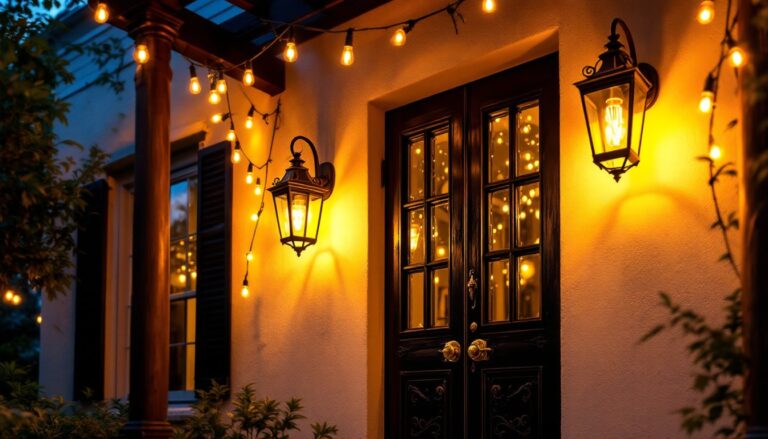
Accent fixtures, uplights, spotlights, and string lights, add visual interest. Uplights mounted at ground level throw light upward onto trees or architectural features. Solar string lights (café-style or lanterns) create ambiance on patios and decks. These typically require a larger central battery pack tethered to a PV panel, so plan placement carefully. Unlike path lights, they can’t be repositioned casually without some cable management.
Solar Security and Motion-Activated Lights
Solar motion-activated lights combine a PIR (passive infrared) sensor, a bright LED, and a chunky battery pack to deliver high lumens on demand. When motion is detected, they can produce 800–2,000 lumens, genuinely bright enough to startle an intruder or light up a driveway at night. Most operate in “motion mode” (only bright when triggered) or “dusk-to-dawn mode” (always on at low brightness, brightening on motion). Motion mode extends battery life significantly because the LED doesn’t run continuously.
Installation is still simple: mount on a wall or eave, aim the sensor, and ensure the PV panel gets direct sunlight. Sensitivity and timer adjustments are handled by dials or buttons on the fixture. Be aware that these lights are bulkier and often don’t match decorative path lights aesthetically, think function first, style second. For homeowners focused on security lighting for the home, a motion-activated solar fixture covering entry doors or dark corners is a practical, no-permit solution that delivers real deterrent value without wired infrastructure.
If you’re considering a full outdoor lighting scheme, resources like Gardenista offer solid inspiration for blending security and aesthetic lighting into a cohesive landscape design.
Key Factors to Consider Before Installing Solar Lights
Sunlight exposure is the non-negotiable variable. Solar lights need direct sunlight for 6–8 hours daily to charge fully. A fixture in deep shade under a tree canopy or nestled against a north-facing wall will charge poorly and deliver weak output at night. Before buying, observe the site at midday and early afternoon: if it’s in shadow most of the day, skip solar for that spot or wait until you can thin nearby branches.
Color temperature and brightness matter for aesthetics and purpose. Path lights in warm white (2,700–3,000 Kelvin) complement residential settings: cool white (5,000K) looks institutional and is better for security zones. Lumens vary wildly, 20 lumens is barely visible, while 100 lumens per fixture lights a path adequately. For accent or security uses, plan on 800+ lumens.
Battery chemistry has evolved. Older solar lights used NiMH (nickel-metal hydride) batteries, which self-discharge and degrade faster. Modern fixtures use lithium-ion or LiFePO4 batteries, which hold charge longer and last 5+ years. Yes, they cost more upfront, but the longevity justifies it. Check product specs, if the manual doesn’t mention battery type, contact the seller.
Seasonal performance varies by climate. In northern regions with short winter days and low sun angles, solar lights will charge slower and run dimmer November through February. Budget accordingly. In southern regions with consistent daylight, you’ll get year-round performance.
Frost and weathering aren’t usually concerns, most solar lights are rated for outdoor use. But, check the IP (Ingress Protection) rating. IP65 means dust and water-jet resistant: IP67 means submersible for short periods. Budget units are often IP54 or lower, so they won’t survive heavy rain or hose spray without degradation. For deck or patio edge lights, go IP65 minimum.
According to Fine Homebuilding, when considering outdoor lighting alongside other home energy upgrades, solar fixtures pair well with reflective landscaping and lighter-colored hardscape materials, which amplify available light naturally. This is a small but meaningful detail: a light-colored patio or walkway reflects more photons, making solar lights appear brighter.
Installation prep is often overlooked. Remove grass and weeds where path lights will go, a stick driven into soil doesn’t stay level over time. Level the base slightly so the light doesn’t tilt. For motion-activated fixtures, ensure the sensor isn’t pointed at a heat source (AC unit, grill) that could trigger false alarms. Test placement for a day or two by positioning lights with rocks before committing to permanent stakes.
Step-by-step solar light installation guides are available on Instructables, where you’ll find maker community tips on weatherproofing connections and retrofitting existing fixtures with solar components. DIYers often share clever hacks there, worth browsing before you buy.
Conclusion
Solar powered outdoor lighting delivers genuine value: no wiring, no permits, no monthly electric charges, and the flexibility to adjust placement whenever you want. Start with a small investment, a handful of mid-range path lights from a reputable brand, to validate performance in your specific sunlight conditions. Once you see they work, expand to accent or security fixtures. The technology has matured enough that you’ll get reliable, bright lighting without the contractor invoice.